00The method
Four filters. The same order, for every company.
We propose and implement interventions. The filters show where we intervene and in what order.
01Film F1 · Evolved Business ArchitectureFilm · 1:06
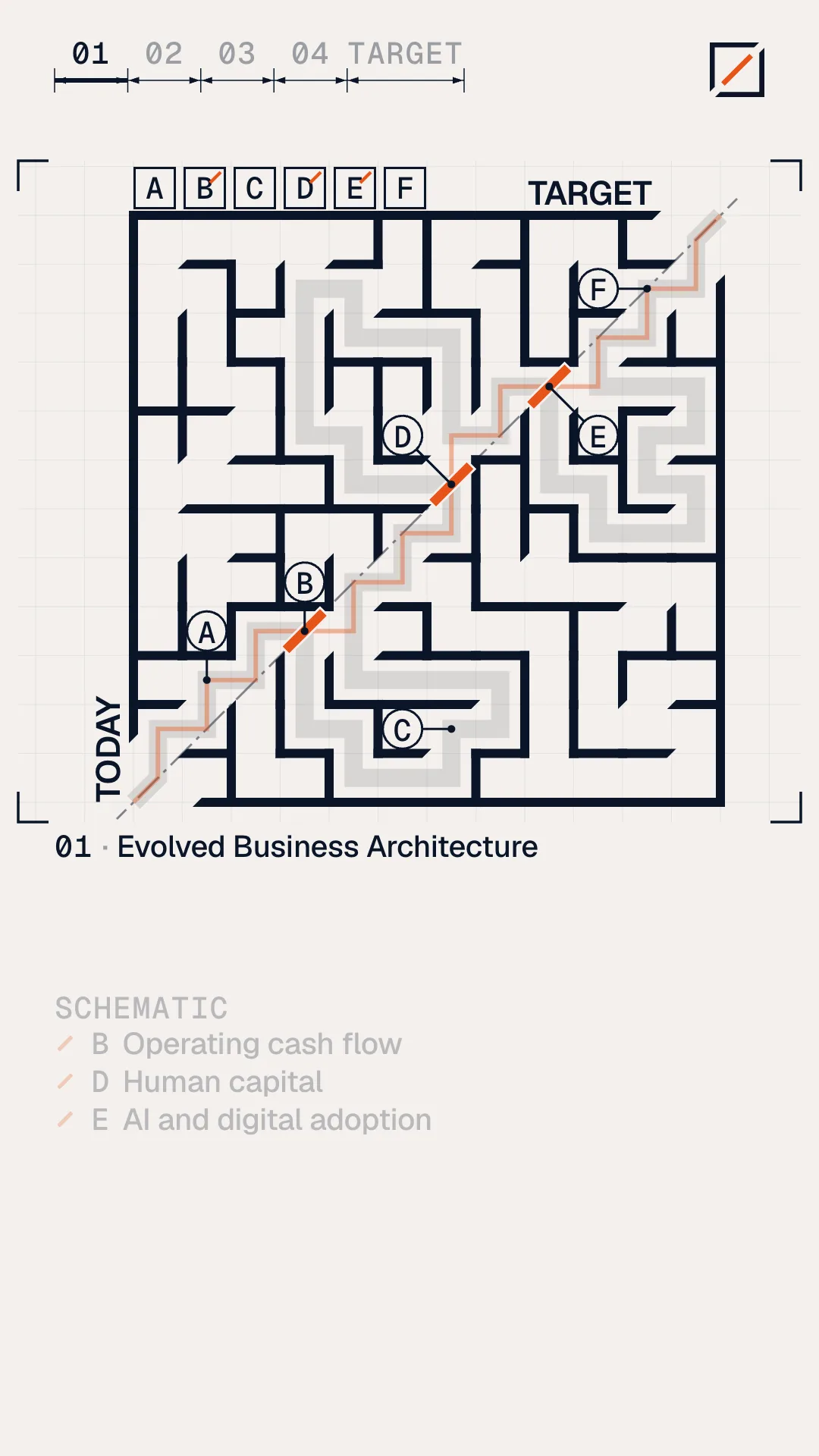
Film transcript F1: Evolved Business Architecture
A maze on a drawing plate: the real structure of the company, with the entrance marked TODAY at the bottom left and the target at the top right. An orange marker enters diagonally through the lower opening.
“We read the company’s real structure.” Next to the maze, a table with six dimensions appears, still faded. The marker travels the real path, turn by turn, and leaves a grey trail behind it. “How decisions are made. Where money flows.” “Who holds authority. Where the energy goes.” Along the path, six reference callouts appear one by one, from A to F, and the matching dimension lights up in the table: A, Decision speed; B, Operating cash flow; C, Operational efficiency; D, Human capital; E, AI and digital adoption; F, Scalability. “Six dimensions, read along the real path.” The marker reaches the target and fades out, and three walls turn orange.
Under the table, the RealTime Score scale is drawn, from 0 to 100, and a marker appears on it. “The result: a map of critical points and the RealTime Score.”
Along the diagonal between TODAY and TARGET, the axis of the intervention is traced as a dash-dot line. The three orange walls rotate onto the diagonal, one by one, and become the bar of the RealTime mark: these are the levers. “Here, three levers shorten the path.” The diagnosis produces the first 3 to 5 intervention levers; the company in the film has three. The levers are linked to dimensions B, D and E; the links between levers and dimensions are schematic.
The path opens, orange, along the diagonal, from today to the target. “Real structure shows where we intervene.” The full method: realtime.ro/en/method.
At the end: the portrait of Ion Cătuțoiu, RealTime Business Studio, “founded by Ion Cătuțoiu”, realtime.ro/en/about.
01Evolved Business Architecture
We read a company’s real structure and find the levers.
What it does
It reads the structure behind the figures, across six dimensions: decision speed, operating cash flow, operational efficiency, human capital, AI and digital adoption, scalability.
What it produces
- A structural map of the critical points.
- The RealTime Score, from 0 to 100, calculated across the six dimensions.
- The first 3–5 intervention levers, with maximum impact.
02Film F2 · Frontier TargetFilm · 1:00

Film transcript F2: Frontier Target
The same maze: the real structure of the company, with TODAY at the bottom left and the target at the top right. An orange marker enters through the lower opening and, from its tip, a dashed line sets off along the diagonal.
“We set the company’s precise destination.” The maze fades. At the upper opening, a small circle closes, marked TARGET; at the entrance, a solid square marks TODAY. Between them, the calculated path is traced as a dashed line: a staircase that climbs alongside the diagonal. “The target, calculated from real structure and resources.” “Frontier Target is engineering.”
Next to the maze, a coordinate table is drawn. “From today to target: four axes.” Each row holds one axis: timeline, cash flow, people, processes. For each axis, the table shows today’s position, marked with the solid square, and the target position, marked with the circle, joined by a dashed line.
Three short ticks appear on the calculated path: the indicators that track the trajectory. “The risk register and the indicators track the trajectory.” Alongside the map, the filter produces the risk register and these indicators, which show early on whether the trajectory holds. “Target: a structure built for the volume the market allows.”
Over the calculated path, the axis of the intervention is traced as a dash-dot line: the calculated path climbs alongside it. “We calculate the path before any investment.” The full method: realtime.ro/en/method.
At the end: the portrait of Ion Cătuțoiu, RealTime Business Studio, “founded by Ion Cătuțoiu”, realtime.ro/en/about.
02Frontier Target
We calculate the target from the real structure and resources, across four axes.
What it does
It sets the organisation’s precise destination: where the company can go with the structure and resources it has or can build. It shows which structure will carry the volume the market will bear, when the market is ready for it.
What it produces
- The map from today’s state to the target state, across four axes: timeline, cash flow, people, processes.
- The risk register.
- The indicators that confirm the trajectory early.
03Film F3 · Return on IntelligenceFilm · 1:11

Film transcript F3: Return on Intelligence
The same maze, with TODAY at the bottom left and the target at the top right. An orange marker enters through the lower opening and travels the real path without stopping, leaving a grey trail behind it. “Is the company becoming smarter, or just larger?”
The view pulls back. From the corners of the frame, phantom lines draw a larger square: 16 by 16 modules instead of 12 by 12. The lines become the frame, and new walls grow in the new space. Today’s maze stays exactly as it was, in the bottom-left corner, outlined with a phantom line. The frame grows with the company and keeps its shape. “The company grows.” The marker continues from the old target and travels the new part of the path. Next to the maze, two bars compare the path lengths, as an illustration in modules: 59 today, 79 after growth. “Larger: the path to the target grows to 79 modules.” “We measure the company’s capability alongside its size.”
Along the long diagonal, the axis of the intervention is traced. The three levers of today’s company rotate onto the diagonal, as in the first film. Then a wall in the new part rotates as well: the fourth lever. “The three levers remain. Growth brings a fourth.” The number of levers follows from the structure that was read: the diagnosis produces the first 3 to 5 levers; today’s company has three, and the new part, added through growth, brings one more.
The path opens, orange, along the diagonal. A third bar, in orange, shows the path with the levers open: 31 modules. “Smarter: the path drops to 31 modules.” The figures are modules of the drawing and illustrate the principle.
Next to the maze, the four components the filter measures appear: operational efficiency, AI automation, commercial optimisation and structural scaling. “We measure at the baseline and at the checkpoints.” The checkpoints are agreed at the outset of the intervention, and the measurements use the same data, so that progress is comparable.
“What counts is the company’s own capability, afterwards.” The full method: realtime.ro/en/method.
At the end: the portrait of Ion Cătuțoiu, RealTime Business Studio, “founded by Ion Cătuțoiu”, realtime.ro/en/about.
03Return on Intelligence
Is the company becoming more intelligent, or simply larger? We measure which.
What it does
It measures whether investment in structure and AI builds real capability alongside volume. Lasting returns come when internal capability grows together with revenue.
What it produces
- A measurement across four components: operational efficiency, AI automation, commercial optimisation, structural scaling.
- The same data, measured at the baseline and at the checkpoints agreed at the outset.
- A clear picture of what the organisation can do on its own after the intervention.
04Film F4 · The Pareto 80:20 FilterFilm · 1:03

Film transcript F4: The Pareto 80:20 Filter
The same maze, with TODAY at the bottom left and the target at the top right. One wall turns orange, then two more. “A few levers bring most of the effect.”
Next to the maze, the principle is drawn: two rows of ten cells. In the first row, two cells carry the orange bar of the lever; from them, lines lead to the second row, where eight cells fill in. “The 80:20 principle: 20% of levers bring 80% of the effect.”
The orange marker travels the company’s real path. Along the diagonal between TODAY and TARGET, the axis of the intervention is traced, and the three levers rotate one by one and become the bars of the mark. Alongside, a dimension marked “illustration” shows the length of the path in modules: after each lever, the path shortens from 59 modules to 47, to 35, then to 23. “The levers with the greatest effect come first.” The path opens, orange, along the diagonal. “Value appears from the first lever.”
“Here, three walls shorten the path to the minimum.” The figures are modules of the drawing and illustrate the principle, verified on this maze.
Next to the maze, a bar split in two is drawn: 80% fills in, 20% stays an outline. “The intervention: 80% structure, 20% AI. In that order.” Structure first (decisions, flows, roles, processes), then amplification with artificial intelligence. The same discipline applies in four places: in selection, in diagnosis, in intervention and in timing.
“We work first on what matters most.” It all starts with the first meeting: realtime.ro/en/meeting.
At the end: the portrait of Ion Cătuțoiu, RealTime Business Studio, “founded by Ion Cătuțoiu”, realtime.ro/en/about.
04The Pareto 80:20 Filter
The levers with the greatest effect are implemented first.
What it does
It applies the same discipline in selection, diagnosis, intervention and timing: the few causes that matter, 80% structure and 20% AI, value from the first lever.
What it produces
- The short list of interventions that matter, in the order they are carried out.
- The schedule in which the levers with the greatest effect come first.
05The principles
The filters are the logical projection. The principles are the structure.
General notesApplied to every intervention
- N.1Structure before tools
- N.2Architecture before automation
- N.3Decisions on verified data
- N.4Implementation owned through to the result
- N.5Clear governance: confidentiality, contract, roles
The principles and the methodology stay the same. The implementation and the solutions are tailored.
We work with companies that share these principles.
F5Film F5 · Shared principlesFilm · 1:02

Film transcript F5: Shared principles
The same maze, after the four filters: the interior faded, three orange bars on the diagonal and the open path. The frame of the maze is drawn in a firm line. First the path lights up, then the frame. “The filters are the logical projection. The principles are the structure.” The frame is the same for every company; the interior differs from one company to the next.
Next to the frame, five reference callouts appear, from P1 to P5, and fill in one by one, one for each principle: “Structure before tools.” “Architecture before automation.” “Decisions on verified data.” “Implementation owned through to the result.” “Clear governance: confidentiality, contract, roles.”
The frame stays in place while the interior changes twice: the interiors of two other companies appear, each with its own walls. “The principles and the methodology stay the same.” The interior returns to the company in the film, with its own levers and path. “The implementation and the solutions are tailored.” It all starts with the first meeting: realtime.ro/en/meeting.
At the end: the portrait of Ion Cătuțoiu, RealTime Business Studio, “founded by Ion Cătuțoiu”, realtime.ro/en/about.
06Terms
Definitions
Show the definitions · 10Hide the definitions
- Business architecture
- The discipline that designs how a business works: how decisions are made, how money flows, who holds authority, how processes connect and where technology comes in. At RealTime, business architecture comes before investment in AI.
- Business Architect
- The role that reads the structure of a business as a system, decides where to intervene and is accountable for implementation. At RealTime, Ion Cătuțoiu, who personally validates every diagnosis, score and recommendation.
- Intervention
- A change to the structure of a business, defined by the diagnosis, directed towards the Frontier Target and owned from design through implementation to knowledge transfer.
- Targeted engagement
- The contractual form of an intervention, with objectives set in the contract. The objective of every engagement: value worth 8× the investment.
- Evolved Business Architecture
- The first filter of the RealTime method. It reads the actual mechanism of the business across six dimensions and produces the map of critical points, the RealTime Score and the first 3–5 intervention levers.
- RealTime Score
- A score from 0 to 100, calculated across the six dimensions of Evolved Business Architecture.
- Frontier Target
- The second filter: the organisation’s precise destination, calculated from its actual structure and resources, across four axes: timeline, cash flow, people, processes.
- Return on Intelligence
- The third filter: it measures whether investment in structure and AI increases the organisation’s own capability, across four components: operational efficiency, AI automation, commercial optimisation, structural scaling.
- The Pareto 80:20 Filter
- The fourth filter: the same discipline in selection, diagnosis, intervention and timing. The levers with the greatest effect are implemented first.
- Lever
- The point in the structure where a small change has a large effect on the whole business.